
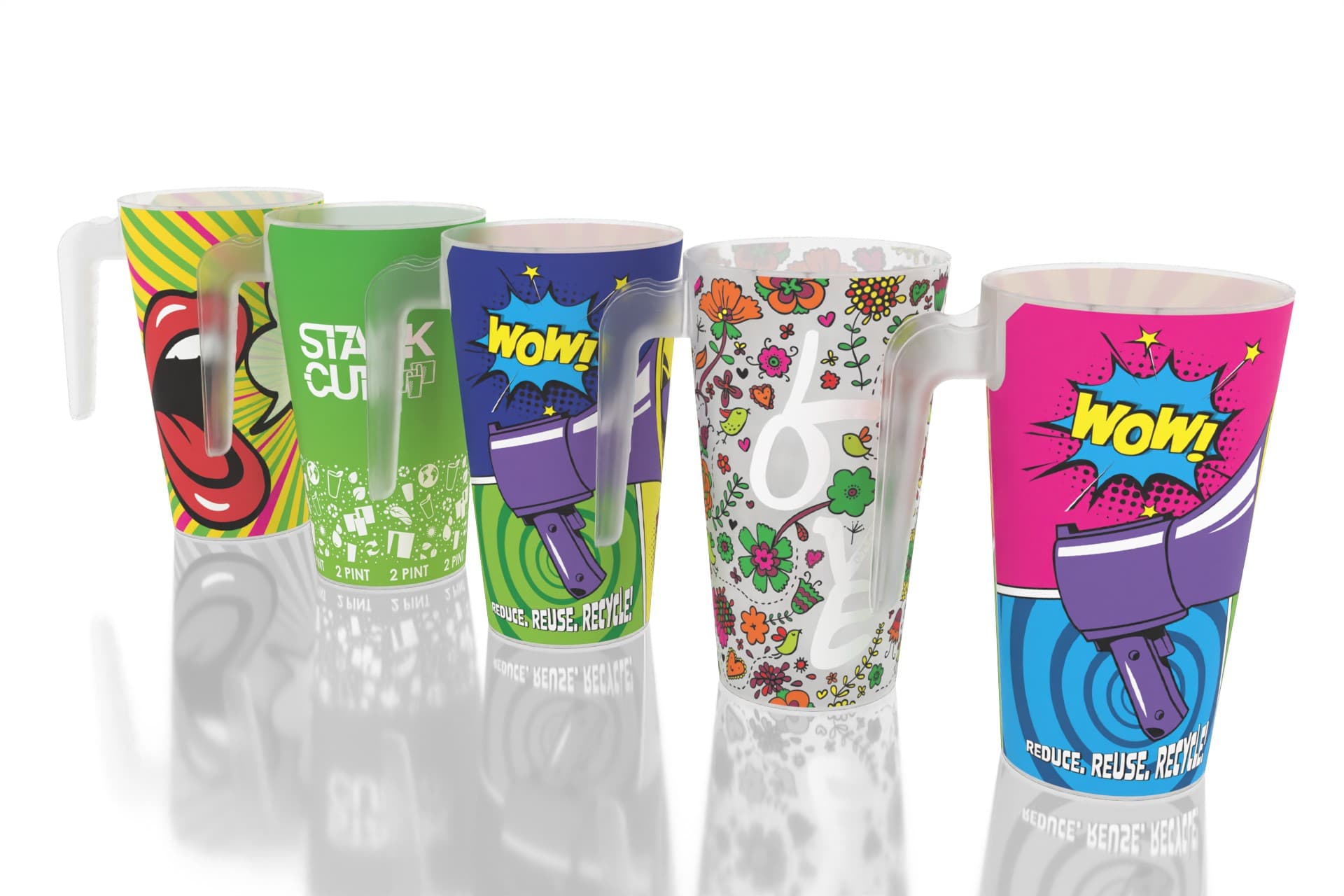
The two pint festival cup is exactly what it sounds like: a single, rigid polypropylene vessel with an approximately 1,100ml capacity, UKCA marked at the two pint measure. It lets your customers carry two pints in one hand, and it is quietly transforming bar operations at festivals, stadiums, and large-scale events across the UK.
If you have ever watched a crowd thin out at the bar during a headliner and wondered how to keep more people buying instead of queuing, two pint festival cups offer one of the simplest operational fixes available. This guide covers how they work, where they make the biggest difference, and what you need to consider before adding them to your drinkware lineup.
The Queue Problem at Festivals
Peak demand periods are unavoidable. When the headliner takes the stage, when the half-time whistle blows, or when the interval hits, thousands of people converge on the bar simultaneously. Every customer joins a queue, orders a single pint, returns to their spot, and then repeats the entire process twenty minutes later.
The result is predictable: queues stretch, service slows, and a significant portion of your potential revenue simply evaporates. Attendees who see a long queue will skip the bar entirely. Those who do queue spend time waiting instead of enjoying the event, and your bar staff are locked into a cycle of high-volume, low-efficiency transactions.
For event organisers, this is not just a customer experience issue. It is a direct hit to your bottom line. Every missed transaction during a peak period is revenue you cannot recover once the rush passes.
How Two Pint Cups Solve It
The logic is straightforward. A customer carrying a two pint cup makes half as many trips to the bar. If your average attendee would normally queue three times during an evening, a two pint option reduces that to one or two visits. Multiply that across thousands of attendees and the impact on queue length is significant.
From the bar side, your staff are serving the same total volume of liquid in fewer individual transactions. Each pour takes marginally longer, but you eliminate the overhead of greeting, payment processing, and cup handling that comes with every separate order. Queue times drop. Throughput increases. Revenue per customer goes up because people are more willing to buy a larger volume when they know they will not have to queue again soon.
The operational case is not theoretical. It is simple maths: fewer transactions for the same volume means faster service and higher spend per head.
Where Two Pint Cups Work Best
Two pint cups are not the right choice for every event, but they excel in specific high-volume scenarios:
- Music festivals with single-point bars - where attendees face long walks back to the bar and want to minimise trips during sets.
- Beer halls and Oktoberfest events - where the culture already centres on large-format drinking and group rounds.
- Stadium and arena concourses - where half-time rushes create intense, short-duration demand spikes.
- Any high-volume venue where reducing bar visits matters - outdoor events, race days, and large-scale private functions.
For events where your primary serve is standard pints, our festival cups in the classic pint format remain the go-to choice. The two pint cup works best as a complement, giving customers the option to upsize when it suits them.
Practical Considerations
Before you add two pint cups to your event, there are a few things worth understanding:
- UKCA marking: Our two pint cups are fully UKCA certified, meaning they are legal for trade service at the two pint measure. Your bar staff can pour directly into the cup and it constitutes a legally compliant measure.
- Deposit schemes: Two pint cups work with deposit and return schemes identically to standard pint cups. The deposit value may be set slightly higher to reflect the larger cup, but the operational process is the same.
- Staff training: Minimal additional training is needed. The pouring process is the same as a standard pint, just a bigger vessel. Staff simply fill to the marked line.
- Storage: Two pint cups have a slightly larger footprint than standard pints, but the integrated handle aids stacking and they store efficiently when nested.
The transition is deliberately simple. If your team can serve a pint, they can serve a two pint cup with no additional process changes.