
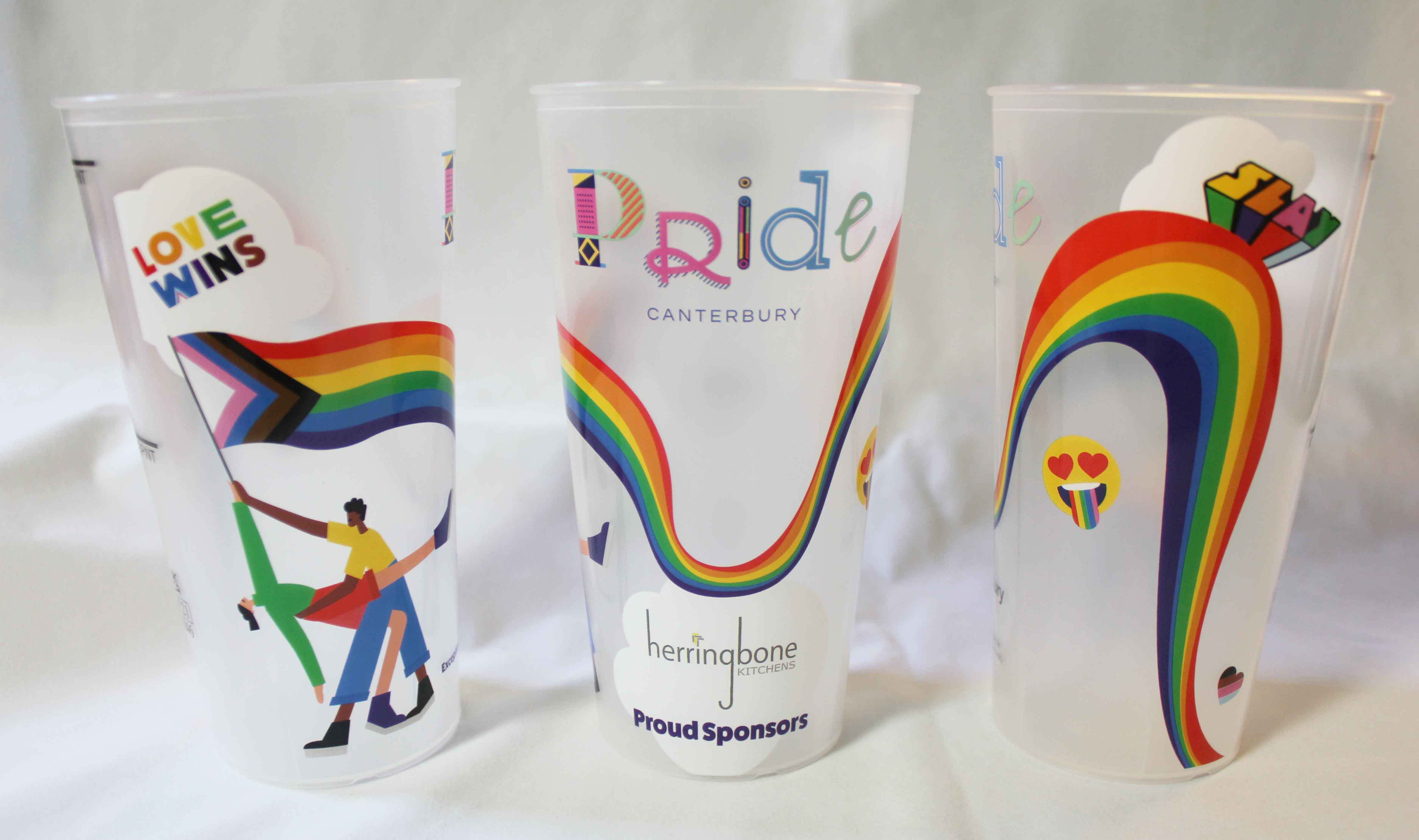
A festival pint is a reusable plastic pint cup, holding 568ml at a printed fill line, carrying a UKCA measure mark that makes it legal for serving draught beer and cider on licensed premises in Great Britain. It differs from a pub pint glass in material and durability, not in volume. A UK pint is 568ml (precisely 568.261ml) whether it is served in glass or in polypropylene.
We apply the UKCA line measure ourselves during production at our factory in Stockton-on-Tees, so the compliance detail below comes from the manufacturing side.
How many ml is a pint?
A UK imperial pint is 568ml, precisely 568.26125ml, which is exactly 20 imperial fluid ounces.
Two related figures worth having:
- A half pint is 284ml.
- A two pint measure is 1,136ml.
A US pint is 473ml, roughly 16 US fluid ounces, which is why an imported “pint” cup is not a legal UK pint. This catches out buyers sourcing from overseas suppliers more often than you would expect.
For practical purposes 568ml is the figure to work with. The extra decimal places matter to the approved body certifying the measure, not to your bar.
To line or to brim: what is the difference?
This is the distinction that decides which cup you order.
Pint to line. The cup holds 568ml when filled to a printed line, with headroom above the line for a head on the beer. This is the standard for draught beer and cider service, because you can pour a proper head and still serve a full legal measure.
Pint to brim. The cup holds 568ml when filled to the rim. There is no headroom. Fine for soft drinks, cocktails and mixers where no head is required and you want maximum usable volume in the cup.
If you are serving draught beer or cider to a stated measure on licensed premises, you need the line measure. If the cup is only used for soft drinks, cocktails, or spirits measured separately with a thimble measure, a brim measure is fine and the line mark is optional. Our guide to reusable plastic cups covers the wider size and material picture.
What do the markings on a pint glass mean?
Look at any legal pint vessel in Great Britain and you will find a cluster of small marks. Each one does a specific job.
| Marking | What it means |
|---|---|
| PINT | The capacity of the measure |
| UKCA | UK Conformity Assessed. Confirms the vessel meets GB legal requirements |
| M | The metrology mark, confirming conformity with legal measurement rules |
| Two digits after the M | The year the conformity marking was applied |
| Four-digit number | The identification number of the approved body |
| Manufacturer mark | Identifies who applied the marking |
So M25 means the conformity marking was applied in 2025. M19 means 2019, M22 means 2022, and so on. It is a manufacturing date stamp for the measure certification, nothing more. It does not indicate a batch, a quality grade or a capacity.
Why is it UKCA and not CE now?
Short history, because it explains why you will see both marks in circulation.
British pint vessels carried a crown stamp as a declaration of accurate measure as far back as 1698. Before 2006 it was applied by local authority Trading Standards officers and government-approved verifiers, and took the form of St Edward’s Crown with the verifier’s identification number beneath it.
The 2004 EU Measuring Instruments Directive came into force in 2006 and replaced the crown stamp with the CE mark plus the M metrology mark, applied by the manufacturer rather than by an inspector.
Following the UK’s departure from the EU, the UKCA mark replaced CE for goods placed on the market in Great Britain from 1 January 2021. The technical requirements are broadly the same.
In 2021 the government issued guidance allowing manufacturers to apply a crown symbol to beer glasses again, on a voluntary basis, as a decorative mark. It is worth being clear about what that means: the crown is decorative only. Any vessel used to measure and sell drinks must still carry the legally required conformity marking. A crown on its own does not make a cup a legal measure.
Full detail on the marks we apply is on our UKCA certified cups page.
How is a festival pint different from a pub glass?
Same volume, different engineering.
Material. A festival pint is moulded from food-grade polypropylene rather than glass. Shatterproof, which removes glass risk from crowded outdoor spaces. BPA-free and phthalate-free.
Durability. Rated for 200 or more commercial dishwasher cycles. A festival cup is expected to survive a season of wash-and-rotation.
Branding. Glassware is decorated on the surface. A festival cup can be printed with full colour in-mould labelling, which fuses the artwork into the cup wall during moulding, so the design survives every wash the cup does.
Weight and stacking. Lighter, and designed to stack for collection, washing and transport. That matters when you are moving thousands of cups between a bar and a wash point during a service rush.
Cost of loss. A cup lost in a crowd costs pennies. A glass lost in a crowd is a hazard and a bigger write-off.
What size festival cups should you order?
Most festival bars run a mix of pints and half-pints, with two-pint cups added at high-volume bars specifically to halve the number of trips customers make during peak rush.
| Size | Capacity | Where it earns its place |
|---|---|---|
| Half pint | 284ml | Tasting bars, wine and prosecco, lighter sessions |
| Pint to line | 568ml | Main draught service, the default |
| Two pint | 1,136ml | Peak-rush bars, queue reduction |
| Wine | Varies | Hospitality, VIP areas, weddings |
Our full breakdown is in the festival cup sizes guide, and the reusable festival cups page has the range. You can also browse pint cups and half pint cups directly.